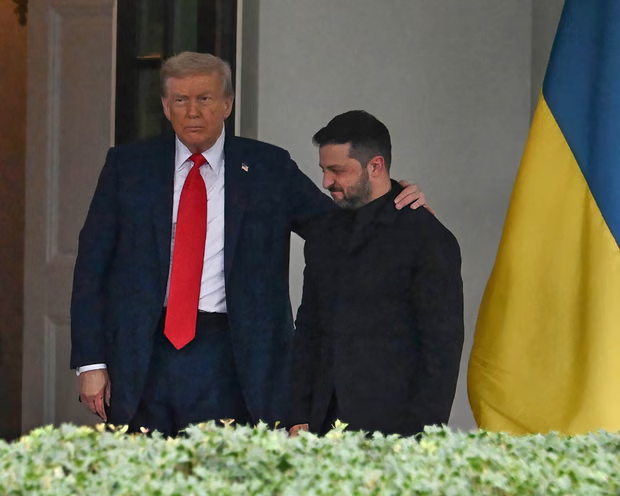
Key Takeaways from Trump’s White House Meeting with Zelensky and European Leaders
The recent White House meeting between former U.S. President Donald Trump, Ukrainian President Volodymyr Zelensky, and several European leaders has drawn significant global attention.
Coming at a crucial point in the ongoing Russia-Ukraine conflict, the meeting provided a stage for frank discussions on military aid, diplomacy, peace talks, and the broader transatlantic alliance.
While no final decisions were announced, the discussions revealed shifting dynamics in U.S. and European approaches to the war and highlighted the complexities of balancing national interests with international responsibilities.
Below, we break down the four main conclusions from the talks and explore their broader implications for Ukraine, the United States, and Europe.
1. Renewed but Conditional U.S.-Ukraine Relations
One of the clearest signals from the meeting was Trump’s acknowledgment of the importance of U.S.-Ukraine relations, though framed with a strong emphasis on accountability.
Unlike past administrations that have provided large-scale aid packages with fewer restrictions, Trump stressed that any future U.S. assistance would need to demonstrate transparency and measurable outcomes.
For Ukraine, this conditionality is a double-edged sword.
On one hand, it secures ongoing U.S. involvement at a time when Kyiv relies heavily on Western support.
On the other, it raises concerns about whether future aid could be delayed or reduced if disagreements emerge over how funds are managed.
Zelensky sought to reassure both U.S. and European counterparts by pledging continued oversight of aid distribution, signaling his awareness of how critical U.S. backing remains for Ukraine’s defense.
From an American perspective, Trump’s message reflects broader domestic debates about foreign spending.
Many U.S. voters remain divided on whether billions in taxpayer money should continue to flow overseas, particularly during a period of economic challenges at home.
By framing aid as conditional, Trump positions himself as both supportive of Ukraine and cautious about American interests.
2. European Leaders Urge Unity and Stability
The presence of European leaders at the White House highlighted Europe’s deep investment in Ukraine’s future.
Countries like France, Germany, and Poland have already contributed substantial financial, military, and humanitarian support to Kyiv, and they continue to push for a unified Western front.
During the meeting, European representatives made clear that divisions between Washington and Brussels could weaken Ukraine’s position on the battlefield and at the negotiating table.
Their message was straightforward: Western unity is essential.
Yet, cracks within Europe itself also complicate matters.
Some EU nations, particularly those geographically closer to Russia, favor stronger support for Ukraine, while others are increasingly concerned about the economic toll of prolonged conflict.
By participating in the White House discussions, European leaders aimed to reaffirm a collective stance while also pressing the U.S. to remain firmly engaged.
3. Peace Talks: A Divisive but Central Issue
Perhaps the most sensitive topic raised during the meeting was the question of peace talks with Russia.
Zelensky’s position remained firm: negotiations must be based on fair conditions that respect Ukraine’s sovereignty and territorial integrity.
He reiterated that Kyiv cannot accept terms that legitimize Russian occupation of Ukrainian territory.
Trump suggested that the U.S. could play a stronger role in facilitating dialogue, even hinting that his leadership could push both sides closer to a deal.
His comments reflect his longstanding claim that he could end the war more quickly than current leaders, though he has offered few details on how this might be achieved.
European leaders urged caution, warning that premature peace talks could risk rewarding aggression and embolden Moscow.
At the same time, they acknowledged growing public pressure within their own countries to explore diplomatic solutions.
The takeaway here is that while peace remains the ultimate goal, the path toward it is fraught with disagreement.
Ukraine insists on justice and sovereignty, while some Western voices see negotiation—however imperfect—as the only viable way to stop a prolonged and costly war.
4. Shifting Transatlantic Dynamics
The meeting also underscored the shifting balance within transatlantic relations.
Trump’s central role in the discussions highlighted his ongoing influence on global politics, particularly as the 2024 U.S. election looms.
For European leaders, this presents both challenges and opportunities.
On one hand, Trump’s unpredictability and past criticisms of NATO raise questions about the reliability of U.S. commitments.
On the other hand, engaging with him now signals a pragmatic recognition that his potential return to power could reshape Western strategy toward Ukraine.
The underlying message is clear: Europe cannot afford to depend solely on U.S. leadership.
While Washington remains the largest supplier of military aid, European nations are increasingly discussing ways to strengthen their own defense capabilities and reduce reliance on American political cycles.
The Bigger Picture: What This Means for Ukraine and the World
The White House meeting revealed more about the state of global politics than about immediate policy changes.
Still, several key themes emerged:
Ukraine remains at the center of Western strategy.
Despite differences in approach, the U.S. and Europe continue to see Ukraine’s survival as essential to broader security.
Domestic politics matter.
Trump’s conditional support reflects U.S. voter sentiment, while European caution reflects pressure from citizens tired of the economic impact of war.
Peace remains elusive.
While all sides talk about ending the conflict, deep divisions over what peace should look like prevent meaningful progress.
In the near term, the meeting is likely to boost Zelensky’s diplomatic visibility while keeping Ukraine high on the global agenda.
For Trump, it provides an opportunity to showcase his foreign policy relevance.
For Europe, it reaffirms the need to balance U.S. leadership with its own independent strategies.
Conclusion
The meeting between Trump, Zelensky, and European leaders at the White House was less about immediate decisions and more about signaling positions.
It underscored the fragility of international alliances, the difficulty of balancing military aid with accountability, and the challenges of finding a diplomatic path forward.
For Ukraine, the stakes remain existential.
For the United States and Europe, the challenge lies in maintaining unity while managing domestic pressures and strategic differences.
Ultimately, the discussions highlighted the reality that the war in Ukraine is not just a regional conflict—it is a global issue that will continue to shape international relations for years to come.